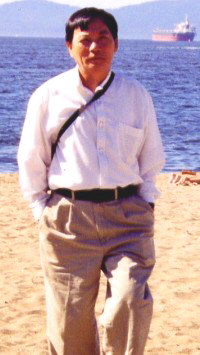
ADAM ZAGAJEWSKI
The Greenhouse
In a small black town, your town,
where even trains linger unwilling,
anxious to be on their way,
in a park, defying soot and shadows,
a gray building stands lined with mother-of-pearl.
Forget the snow, the frost's repeated blows,
inside you're greeted by a damp anthology of breezes,
and the enigmatic whispers of vast leaves
coiled like lazy snakes. Even an Egyptologist
couldn't make them out.
Forget the sadness of dark stadiums
and streets,
the weight of thwarted Sundays.
Accept the warm breath wafting from the plants.
The gentle scent of faded lightning
engulfs you, beckoning you on.
Perhaps you see the rusty sails of ships at port,
islands snared in rosy mist, crumbling temples' towers;
you glimpse what you've lost, what never was,
and people with lives like
your own.
Suddenly you see the world lit differently,
other people's doors swing open for a moment,
you read their hidden thoughts, their holidays don't hurt,
their happiness is less opaque, their faces
almost beautiful.
Lose yourself, go blind from ecstasy,
forgetting everything and then perhaps
a deeper memory, a deeper recognition will return,
and you'll hear yourself saying: I don't know how -
the palm trees opened up my greedy heart.
Letter from a
Reader
Too much about death,
too many shadows.
Write about life,
an average day,
the yearning for order.
Take the school bell as your model
of moderation,
even scholarship.
Too much death,
too much
dark radiance.
Take a look,
crowds packed
in cramped stadiums
sing hymns of hatred.
Too much music
too little harmony, peace,
reason.
Write about those moments
when friendship's foot-bridges
seem more enduring
than despair.
Write about love,
long evenings,
the dawn,
the trees,
about the endless patience
of the light.
Long Afternoons
Those were the long afternoons when poetry left
me.
The river flowed patiently, nudging lazy boats to sea.
Long afternoons, the coast of ivory.
Shadows lounged in the streets, haughty manikins in shop fronts
stared at me with bold and hostile eyes.
Professors left their schools with vacant faces,
as if the Iliad had finally done them in.
Evening papers brought disturbing news,
but nothing happened, no one hurried.
There was no one in the windows, you weren't there;
even nuns seemed ashamed of their lives.
Those were the long afternoons when poetry vanished
and I was left with the city's opaque demon,
like a poor traveler stranded outside the Care du Nord
with his bulging suitcase wrapped in twine
and September's black rain falling.
Oh tell me how to cure myself of irony, the gaze
that sees but doesn't penetrate; tell me how to cure myself
of silence.
Translated from the Polish by Clare Cavanagh
Partisan Review. Winter 1998