John Gray
Being Human
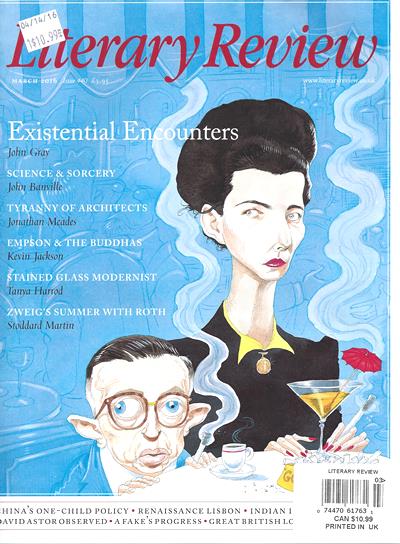
At the Existentialist Café: Freedom, Being and Apricot Cocktails
By Sarah Bakewell
In 1962, Martin Heidegger went on a cruise to the Aegean. Going to Greece
had not been an easy decision. Seven years earlier he had got so far as to
buy train and boat tickets; when the enormity of what he was attempting dawned
on him, he cancelled the trip. He tried again in 1960, and once more called
the trip off. Visiting the homeland of the oracular pre-Socratics and the
only truly ‘philosophical’ language apart from German was too much of a
risk. When he finally screwed up the courage to take the cruise, he hated
the country he found. With Olympia now a mass of ‘hotels for the American
tourists’, the ancient site no longer ‘set free the Greek element of the
land, of its sea and its sky’. When the boat reached Crete and Rhodes, he
stayed on board reading Heraclitus.
Sarah Bakewell’s witty account of Heidegger’s journey recalls the philosopher
Sidney Morgenbesser’s response to the Heideggerian question, ‘Why is there
something rather than nothing?’ ‘Even if there had been nothing,’ Morgenbesser
is supposed to have quipped, ‘he’d still not be satisfied.’ Heidegger was
a central figure in generating the loosely defined current of thought commonly
known as existentialism. His own thought was in many ways derivative, but
he never allowed a debt – intellectual or personal – to stand in the way
of his own advancement. He owed his academic career to Edmund Husserl, who
more than anyone else originated existentialist thinking with his call for
the direct study of human experience – phenomenology – to be accepted as
the foundation of philosophy, and whose chair at the University of Freiburg
Heidegger inherited. But Heidegger did nothing to assist his mentor in 1933
when Husserl was prevented from using university facilities under Nazi laws
requiring the dismissal of Jewish academics, failed to attend Husserl’s
funeral in 1938 and removed the dedication to Husserl in the 1941 edition
of Being and Time. An enormous literature exists on Heidegger’s relations
with Nazism, but Sartre captured an essential part of that involvement when
he wrote in an essay of 1944: ‘Heidegger has no character; there’s the truth
of the matter.’ As a human being, Heidegger was less than nothing.
Author of an inspiriting life of Montaigne, Bakewell clearly likes writing
about thinkers for whom she can feel admiration and affection. To her credit,
she does not flinch from recording Heidegger’s squalid manoeuvrings during
the Nazi period and his unending evasions thereafter. She does a good job
tracing Heidegger’s influence on the French thinkers who turned phenomenology
into something like an intellectual movement, the inception of which she
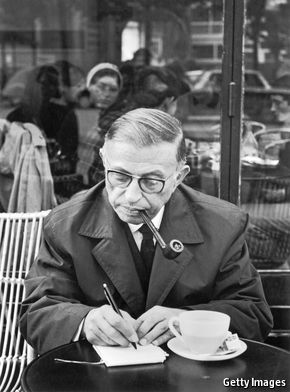
dates to a conversation near the end of 1932, in the Bec-de-Gaz bar on rue
Montparnasse in Paris, between Jean-Paul Sartre, Simone de Beauvoir and
Sartre’s old school friend and later political opponent Raymond Aron, who
had been studying in Berlin. Aron described the phenomenological philosophy
he had encountered in Germany: ‘if you are a phenomenologist, you can talk
about this cocktail and make philosophy out of it!’ De Beauvoir wrote later
that on hearing this Sartre turned pale with excitement. She and Sartre had
tried to read Heidegger’s lecture ‘What is Metaphysics?’ when it appeared
in French in 1931, but ‘could not understand a word of it’. Now they saw
the point: Heidegger was founding a type of philosophy that set aside traditional
concerns with metaphysics and the theory of knowledge in order to examine
the givens of immediate experience, whatever they might be. Aided by their
friend Maurice Merleau-Ponty, who had attended lectures given by Husserl
in Paris, they resolved to promote this new philosophy in France.
In fact, Heidegger wasn’t doing anything new. The Russian-Jewish fideist
Lev Shestov (1866–1938), one of the most interesting thinkers in the history
of existentialism (though not mentioned by Bakewell), recorded that when
he met Heidegger in Husserl’s home in 1928, Husserl was insisting on the
importance of reading Søren Kierkegaard, the heterodox Danish theologian.
Heidegger had already taken the hint. As Shestov later noted, Being and
Time was not much more than a translation of Kierkegaard’s ideas into
Husserlian categories, with religious conceptions of the fall of man reappearing
as hermetic Heideggerian notions such as ‘thrownness’. An indeterminate religiosity
pervades much existentialist writing. In some cases – Shestov and Simone
Weil, the Catholic thinker Gabriel Marcel and the later work of Emmanuel
Levinas, for example – the influence of religion is explicit. But religious
ideas are present in Sartre’s work as well.
Citing a conversation with de Beauvoir in which Sartre declared that
they should work on ‘a great atheist, a truly atheist philosophy’, Bakewell
writes that she is ‘more impressed now than ever by Sartre’s radical atheism,
so different to that professed by Heidegger, who abandoned his faith only
in order to pursue a more intense form of mysticism. Sartre was a profound
atheist, and a humanist to his bones.’ Yet Sartre’s atheism featured a conception
of human action whose origins in theism are unmistakable. As Bakewell notes,
one of the central tenets of existentialist thinking – especially Sartre’s
– is the belief that ‘human existence [is] different from the kind of being
other things have. Other entities are what they are, but as a human I am
whatever I choose to make of myself at every moment. I am free.’ Anyone who
thought of their lives as being in some way ruled by fate was guilty of
the cardinal existentialist sin of inauthenticity – the denial of one’s own
freedom. But where does this idea of freedom come from? Not from the ancient
Greeks or Romans, or from modern science. Plainly, it is a secular version
of the theistic faith in free will. Like much else in 20th-century thought,
Sartre’s existentialism was largely spilt religion.
In Sartre’s case, existentialism was also an intensely political engagement.
Bakewell recounts the philosopher’s convoluted interactions with the French
Communist Party – a dreary tale of self-deception, spotted with elements
of black comedy. It’s a pity she doesn’t explore the episode described in
Carole Seymour-Jones’s A Dangerous Liaison: Simone de Beauvoir and Jean-Paul
Sartre (2008), in which, during a visit to Moscow in 1962, Sartre became
involved in a relationship with a KGB agent. As the agent, Lena Zonina,
wrote in a report at the time, the philosopher’s visit was ‘set up in such
a way as to give him a complete illusion that he meets with anyone he wants
to meet, that he chooses the subjects for conversation, and that he works
out his own programme rather than follows one imposed on him’. Sartre was
taken in by the deception, falling in love with Zonina, an attractive and
highly intelligent but ailing and vulnerable woman who was herself acting
under severe constraint, proposing marriage to her and visiting the Soviet
Union on no fewer than eight occasions within four years in order to be with
her. With Sartre unwilling to make a decisive break with de Beauvoir and
the philosopher’s usefulness to the Soviet cause waning, the relationship
came to an end. But the carefully engineered romance seems to have served
its purpose in bolstering Sartre’s belief that communism ‘must be judged
by its intentions and not its actions’.
Towards the end of this absorbing and enjoyable book, Bakewell writes:
‘Ideas are interesting, but people are vastly more so.’ She presents a cast
of characters who are undeniably diverting. Simone de Beauvoir, in particular,
emerges as a highly complex individual, far more interesting than her egotistical
and gullible partner. Karl Jaspers, frail in health but resolute in his determination
to remain untainted by Nazism; Emmanuel Levinas, who withstood Nazi oppression
and clearly perceived Heidegger’s culpability; Albert Camus, much given
to high-flown rhetoric but with a sense of reality that kept him from Sartre’s
political follies: these were substantial figures. But most of the existentialists
were not particularly distinctive either in their ideas or as human beings.
The ineffably bourgeois Merleau-Ponty, extolling the virtues of ‘proletarian
humanism’ and the necessity of communist terror, was representative of many
of them – a bog-standard mid-20th-century French bien pensant. For
all their talk of authenticity, those who are best known for shaping existentialist
thinking were notable for embodying the fashionable attitudes of their
time.